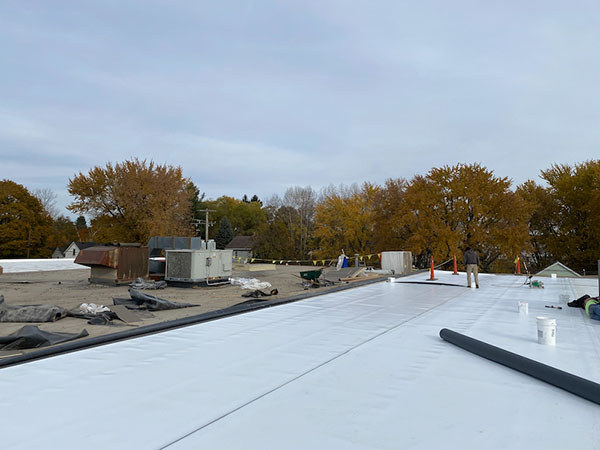
When a commercial flat roof leaks, the stain or drip inside the building may not show where water entered. Moisture can travel through insulation, along decking, or around roof details before it becomes visible indoors. For a Watertown, SD building owner, the useful question is whether the problem is a localized defect that can be repaired or evidence of broader roof damage that needs a wider assessment.
Hoppe Roofing has served commercial properties since 1977 and provides flat roof repair in Watertown. Call (855) 472-4932 to discuss the roof condition and the repair scope being considered.
Flat Roof Repair: Detecting Moisture Before It Spreads
Moisture beneath a flat roof can be easy to underestimate because the visible interior symptom may be smaller than the affected area in the roof assembly. Water that reaches insulation can reduce thermal performance and can contribute to deterioration if the source is not corrected. Freeze-thaw conditions can also add stress at existing openings or damaged details, but the actual effect depends on where the water is, the roof materials, and how the assembly is built.
An interior stain is therefore evidence of a leak, not a complete diagnosis. The contractor should identify the roof-level entry point, determine whether surrounding materials remain serviceable, and decide whether additional moisture investigation is needed before setting the final repair area.
How Hidden Moisture Is Located

Roofing professionals can use visual inspection together with project-specific moisture investigation when concealed conditions could change the repair. Depending on the roof, that may include infrared scanning, moisture meters, test cuts, or other methods. No single method is required for every roof, and no scan or meter reading by itself proves the full repair scope.
Hoppe Roofing’s roof inspection service evaluates roofing materials, flashing, drainage components, and other visible conditions that can affect a commercial roof. Ask the contractor what evidence will be used for your building and how the findings will affect the written repair scope.
What the Evidence on the Roof Tells You
Different symptoms can lead to different scopes. The table below shows what an inspection should confirm before a localized repair is approved.
| What You Notice | What the Inspection Should Confirm | How It Affects the Scope |
|---|---|---|
| Separated or open seams | Condition of the seam along the affected run, nearby membrane, and any prior repairs | A defined seam defect may support localized repair if surrounding materials remain serviceable |
| Leak near a vent, curb, or rooftop unit | Flashing, seals, membrane transitions, and whether moisture extends beyond the detail | A detail repair may fit when the surrounding roof remains suitable |
| Water near walls or roof edges | Flashing attachment, edge condition, membrane movement, and supporting materials | The repair may stay local or expand if the transition or substrate also needs corrective work |
| Ceiling stain or suspected wet insulation | Likely moisture extent and the condition of insulation and deck where the scope requires opening the roof | Wet or damaged materials can widen the repair beyond the visible leak point |
| Repeated leaks in different places | Overall membrane condition, age of repairs, drainage, and whether failures are isolated or recurring across larger areas | A broader repair-versus-replacement assessment may be more appropriate than another isolated patch |
What a Flat Roof Repair Includes
A repair that involves concealed moisture should address more than the visible membrane opening. The exact work depends on what is found, but a useful scope can include:
- Defining the repair area from inspection findings and any project-specific moisture investigation.
- Removing wet or damaged insulation where the repair scope requires it.
- Checking exposed decking or supporting materials after the roof is opened and documenting conditions that change the work.
- Installing compatible insulation and repairing or replacing the membrane in the affected section.
- Repairing included flashing, seams, penetrations, or transitions that contributed to the leak.
Wet insulation should not simply be covered and ignored. Whether it can be dried, removed, or otherwise addressed depends on the material, moisture extent, roof design, and the selected repair method. The written proposal should explain what the contractor will do rather than rely on a universal rule.
What a Good Repair Quote Should Cover
A useful quote should identify the repair area, the evidence behind that area, included insulation or deck work, flashing and membrane repairs, exclusions, and the process for handling concealed conditions. It should also explain access, staging, protection of occupied areas where needed, and how weather could affect the schedule. Roof access during assessment and repair should remain with trained crews rather than building staff.
When Repair Makes Sense vs. Replacement
A localized repair may make sense when the defect is defined, surrounding materials remain serviceable, and the expected repair does not leave broader moisture, drainage, or membrane problems unresolved. A broader assessment is more appropriate when leaks recur in multiple areas, moisture appears widespread, the membrane is deteriorated in several locations, or deck and insulation conditions make repeated repairs less practical.
If the findings point beyond a localized repair, Hoppe Roofing’s commercial roof replacement service provides the separate replacement path. A serviceable roof that is not yet ready for replacement may also be evaluated for flat roof coatings after defects and suitability conditions are addressed. The Watertown roof coating guide covers that restoration question separately.
Expert Flat Roof Repair in Watertown
Hidden moisture can turn a small visible symptom into a larger repair question, so the useful goal is to define the actual defect and the condition of the surrounding roof before setting the scope. Hoppe Roofing provides commercial flat roof repair in Watertown, SD and has served commercial roofing customers since 1977.
Call (855) 472-4932 to discuss a Watertown roof. Ongoing roof maintenance can also help identify new seam, flashing, drainage, or membrane problems before they become more disruptive.
Frequently Asked Questions
How do I know if my flat roof has hidden moisture?
Interior staining, membrane changes, or soft areas can indicate a problem, but they do not show the full extent. The contractor may recommend project-specific moisture investigation when concealed conditions could change the repair scope.
Can flat roof moisture damage get worse over winter?
It can. Water in a roof assembly may contribute to freeze-thaw stress at existing defects, but the effect depends on the materials, moisture location, drainage, and condition of the roof.
Does wet insulation always need to be replaced during a flat roof repair?
Not under one universal rule. The contractor should determine how the wet material affects the repair and explain whether it will be removed, dried, or otherwise addressed for the specific roof assembly.
How long does a commercial flat roof repair take?
The timeline depends on the repair area, concealed conditions, materials, access, and weather. A useful proposal gives the schedule after the scope is defined.