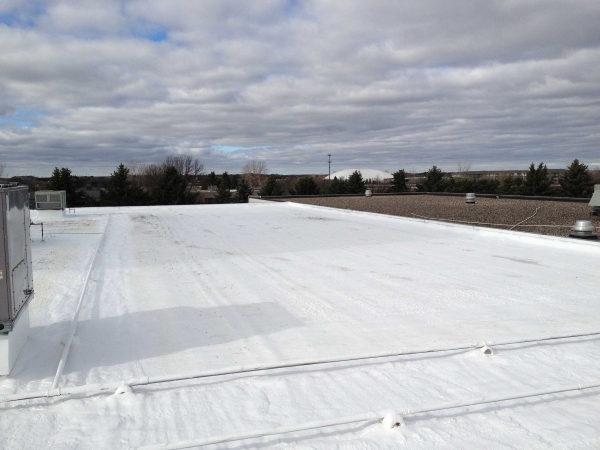
Spray foam roofing can be a practical option for some commercial buildings in Sioux Falls, SD, but it should be selected after the existing roof, drainage, moisture, surface condition, and building use are evaluated. Hoppe Roofing confirms Spray Foam Installation within its commercial roofing scope and serves Sioux Falls within its approved service area.
The useful comparison is not whether spray foam is generally better than a single-ply membrane or roof coating. It is whether the existing roof and project goals support a foam system, a recover with another roofing system, a restoration coating, or a different scope of work.
What Spray Foam Roofing Is

Spray polyurethane foam, often called SPF, is applied as a liquid and expands in place to form a rigid foam layer. A protective coating is installed over the foam to help shield it from ultraviolet exposure and weather. Because the foam is spray-applied, it can form a continuous layer around many roof details, but penetrations, edges, drains, and transitions still require proper project-specific detailing.
The foam layer also contributes insulation value within the roof assembly. That can be useful when insulation performance is part of the project goal, but whole-building energy use still depends on existing insulation, HVAC equipment, air leakage, occupancy, operating schedules, and other conditions. Spray foam should not be treated as a guaranteed energy-savings measure.
When Spray Foam May Be a Good Fit
Spray foam may be worth considering when the existing roof is a suitable substrate, moisture concerns are addressed, drainage is understood, and the building has roof geometry or penetrations that make a spray-applied system practical. The decision should follow an evaluation rather than a preset preference for foam.
- Complex roof geometry: A spray-applied system can conform around many roof shapes and details, which may be useful on roofs with numerous penetrations or transitions.
- Suitable existing roof: Some roofs may be candidates for an overlay or recover approach when the existing materials, deck, attachment, and moisture condition support it.
- Insulation goals: The foam layer contributes insulation value as part of the roof assembly, although the effect on building energy use depends on the entire building.
- Restoration planning: A properly maintained foam system may be evaluated for recoating later, but the timing and scope depend on the installed system and its condition.
When Another Roofing Option May Make More Sense
Spray foam is not automatically appropriate for every flat or low-slope roof. Wet insulation, deteriorated decking, incompatible surfaces, unresolved drainage problems, or structural concerns can require repair, removal, or further investigation before any recover system is selected.
Rooftop traffic also matters. Frequent service activity around HVAC equipment or other roof-mounted systems may require designated walk areas or other protection. The project should account for how the roof is actually used rather than assume the finished surface will never be walked on.
Compare Spray Foam With Single-Ply Roofing
A single-ply membrane such as TPO, PVC, or EPDM may be a better fit when the roof design, attachment requirements, maintenance priorities, or selected assembly point toward a sheet membrane system. Single-ply roofs use different materials and seam details than spray foam, so the comparison should focus on the complete proposed assembly rather than one feature such as seam count.
Owners should compare preparation, insulation, attachment, flashing, penetrations, drainage work, exclusions, maintenance expectations, and the conditions that could change the scope after concealed materials are investigated.
Compare Spray Foam With a Roof Coating
A roof coating may be considered when the existing roof remains a suitable candidate for restoration and does not need the added foam layer or another new roofing assembly. Coating suitability depends on the existing roof system, surface condition, moisture, adhesion, drainage, and required repairs.
A coating should not be treated as an automatic lower-cost substitute for spray foam or replacement. The correct comparison depends on how much preparation is required, what the existing roof needs, and what each proposal actually includes.
Start With the Existing Roof
Before choosing spray foam, single-ply, or a coating, the existing roof should be evaluated. Hoppe Roofing’s roof inspection information for Sioux Falls provides context for examining roof condition before setting a larger project scope.
An evaluation should consider visible membrane or surface condition, drainage, previous repairs, penetrations, substrate concerns, and signs that moisture investigation may be needed. If concealed conditions cannot be confirmed during the initial visit, the proposal should identify that limitation rather than assume the entire roof is suitable for a recover system.
Plan for Maintenance After Installation
A spray foam roof still requires ongoing inspection and maintenance. The protective coating, drainage areas, penetrations, and locations affected by foot traffic or later rooftop work should be monitored. Damage to the protective surface should be addressed before it exposes more of the foam beneath it.
Recoating may be part of the long-term maintenance plan for some spray foam systems, but there is no universal interval that applies to every roof. Timing depends on the coating system, exposure, maintenance history, warranty requirements, and the condition found during inspection.
Spray Foam Roofing in Sioux Falls, SD
Hoppe Roofing has served commercial and industrial customers since 1977 and confirms Spray Foam Installation, Single-Ply Installation, Acrylic Roof Coatings and Restoration, and General Commercial Roofing within its current commercial scope. Sioux Falls is within the company’s approved service area.
For a Sioux Falls property, the best roofing option should follow the existing roof condition, moisture and drainage findings, insulation goals, rooftop use, and the complete project scope. Contact Hoppe Roofing at (855) 472-4932 to discuss whether spray foam roofing should be considered for the building.
Frequently Asked Questions
Can spray foam roofing be installed over an existing commercial roof?
Sometimes. Suitability depends on the existing roof assembly, deck and substrate condition, moisture, attachment, drainage, surface preparation, and other project-specific requirements that should be evaluated first.
Is spray foam roofing better than single-ply roofing?
Not universally. Spray foam and single-ply systems use different assemblies and installation methods. The better fit depends on the building, existing roof, drainage, attachment needs, rooftop use, and project goals.
Does a spray foam roof need to be recoated?
Recoating may be part of the long-term maintenance plan for some systems, but timing depends on the installed coating, exposure, maintenance history, warranty requirements, and current condition.
Is spray foam a good option for a roof with many penetrations?
It can be. A spray-applied system can conform around many roof details, but penetrations, drains, edges, and transitions still require proper detailing and should be included clearly in the project scope.