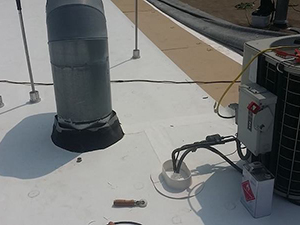
A commercial roof is one of the most significant components of any building, and replacing it is a major investment. Most property owners want to get every possible year out of an existing roof before committing to that cost, which is a reasonable approach. The challenge is knowing when repairs and maintenance have reached their limit and a new roof is the smarter financial decision. Waiting too long can mean escalating repair bills, interior damage, and disruption to tenants or operations.
Hoppe Roofing stands with you to get the most from your roofing investment. To schedule a consultation, call (855) 472-4932.
When Is a Commercial New Roof Needed?
Here is how to recognize when a commercial building in Madison or the surrounding area has crossed that line.
The Roof Has Exceeded Its Expected Lifespan
Every roofing system has a projected service life. TPO and EPDM membranes typically last 20 to 30 years with proper maintenance. Modified bitumen systems average 15 to 20 years. Built-up roofing can last 20 to 30 years depending on the number of layers and how well it has been maintained. Once a roof approaches or exceeds that window, the cost-benefit calculation shifts. Repairs become more frequent, materials become brittle and harder to patch effectively, and the underlying insulation and decking may have absorbed years of minor moisture intrusion. Age alone is not always a reason to replace, but it is a strong signal to get a professional assessment.
Repairs Are Becoming Frequent and Costly
One or two repairs over the life of a roof is normal. When repair calls start happening every season, or when a single repair estimate approaches a significant fraction of replacement cost, the math starts favoring a new roof. Repeat repairs on an aging membrane often address symptoms without solving the underlying deterioration. A roof that has been patched in multiple locations is also more vulnerable because each patch point represents a potential failure. Tracking repair history over time gives property owners a clearer picture of whether maintenance is still a sound investment.
Widespread Membrane Deterioration
Localized membrane damage can be patched. When deterioration is widespread, covering large sections of the roof surface, patching is no longer practical or cost-effective. Signs of widespread membrane failure include extensive cracking, granule loss on modified bitumen systems, widespread blistering, and seams that are separating in multiple locations. At this stage, a full replacement gives the building a fresh waterproofing system with a new warranty rather than a patchwork surface with unpredictable performance.
Persistent Leaks That Cannot Be Traced or Resolved
Some leaks are straightforward to find and fix. Others travel through the roof assembly and show up inside the building far from their actual source, making them difficult to locate and repair reliably. When a roof has a history of leaks that return after repairs, or when water intrusion is showing up in new locations after each rain event, the membrane has likely failed in ways that are not visible from the surface. Interior water damage, including stained ceilings, deteriorating insulation, and mold growth, compounds the cost of inaction.
Structural Issues in the Decking or Insulation
A roof replacement is sometimes triggered not by membrane failure, but by what is underneath. When moisture has penetrated the membrane over time, the insulation becomes saturated and loses its thermal value. The decking beneath can rot or corrode depending on the material. Soft spots underfoot during a roof inspection are a warning sign. If an assessment reveals widespread insulation saturation or decking damage, a new roof is necessary to address the problem properly rather than applying new membrane over a compromised substrate.

Energy Costs Have Increased Without Explanation
A degraded roof system loses thermal efficiency. Saturated insulation no longer performs to its rated R-value, and air infiltration through failed seams and flashings adds to heating and cooling loads. If a commercial building in Madison has seen unexplained increases in energy costs, the roof is worth evaluating. A new roof with updated insulation can meaningfully reduce operating costs over time, making replacement part of a longer-term financial case rather than purely a maintenance expense.
When to Call Hoppe Roofing
If any of these conditions sound familiar, the right next step is a professional roof assessment rather than another repair call. Hoppe Roofing works with commercial property owners across Madison and the region to evaluate roof condition honestly and recommend the approach that makes the most sense for the building and the budget. Sometimes that means targeted repairs. Sometimes it means planning for replacement on a timeline that works for the owner. Either way, a clear picture of roof condition puts property owners in a better position to make the right call.
A new commercial roof is a significant investment, but so is the building it protects. Getting ahead of a full failure is almost always less expensive than responding to one.
To learn more, call Hoppe Roofing today at (855) 472-4932.
FAQ
Does a new commercial roof come with a warranty?
Yes. Most new commercial roofing systems come with manufacturer warranties covering the materials and contractor warranties covering the installation workmanship. Warranty terms vary by roofing system and manufacturer, so it is worth discussing coverage specifics with your roofing contractor before the project begins.
How disruptive is a commercial roof replacement to building operations?
Most commercial roof replacements can be completed with minimal disruption to daily operations. Work is contained to the roof level, and experienced contractors sequence the project to limit noise and odor during occupied hours when possible. Your contractor should walk through the project timeline and any operational considerations with you before work begins.