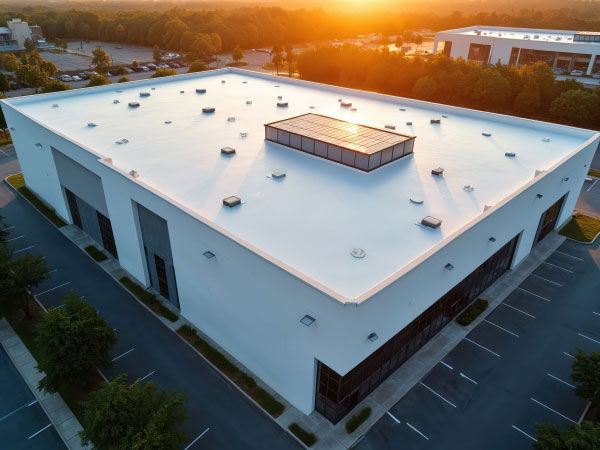
Choosing a single-ply roofing system for a commercial building in Willmar, MN is less about finding one universally best membrane and more about matching the roof assembly to the building. TPO, PVC, and EPDM each have different seam methods, surface characteristics, chemical resistance, color options, and maintenance considerations.
Hoppe Roofing provides commercial single-ply roofing services across Minnesota, Iowa, and South Dakota. Property owners can call (855) 472-4932 to discuss the existing roof, insulation, drainage, rooftop exposure, and which membrane system should be evaluated for the project.
What Single-Ply Roofing Means
Single-ply roofing uses a flexible membrane as the primary waterproofing layer on a low-slope commercial roof. The membrane is installed as part of a complete assembly that can also include insulation, cover board, attachment components, flashing, roof edges, drainage details, and protection around penetrations.
The membrane may be mechanically attached, adhered, or installed through another approved system depending on the product, deck, wind requirements, and project design. Hoppe Roofing’s single-ply roofing guidance for Cedar Rapids provides related context for treating the membrane, attachment, drainage, and details as one roof system.
How TPO, PVC, and EPDM Differ

TPO and PVC are thermoplastic membranes whose seams are typically heat welded. Both are commonly available in light, reflective colors, but product characteristics vary by manufacturer, thickness, reinforcement, and specific formulation.
EPDM is a synthetic rubber membrane. Its field seams are typically joined with adhesive or tape systems rather than heat welding. EPDM is commonly available in black, although system options vary.
These differences matter, but membrane type alone does not determine performance. Installation quality, flashing, drainage, attachment, substrate condition, and maintenance can be just as important as the material selected.
When TPO May Fit the Project
TPO is often considered when a building owner wants a thermoplastic membrane with heat-welded seams and reflective surface options. A light-colored membrane can reduce roof-surface heat gain, but it should not be presented as a guaranteed reduction in utility costs.
Actual building energy performance also depends on insulation, air leakage, HVAC efficiency, roof area, building use, and climate. Ask how the proposed TPO system fits the complete roof assembly rather than choosing it on reflectivity alone.
When PVC May Deserve Comparison
PVC is also a heat-welded thermoplastic membrane and is often evaluated for buildings where grease, oils, chemicals, or certain exhaust conditions are part of the rooftop environment. The actual resistance needed should be checked against the specific membrane being proposed.
Restaurants, food-service facilities, manufacturing buildings, and other properties with unusual rooftop exposure may have reasons to compare PVC closely, but the building’s actual discharge points and product compatibility should guide the decision rather than the occupancy label by itself.
When EPDM May Fit the Building
EPDM has a long history as a low-slope commercial roofing membrane and can be appropriate for many buildings. Because black EPDM absorbs more solar heat than a light-colored reflective membrane, roof color and energy goals may be part of the comparison.
That does not make EPDM automatically worse for energy performance. Insulation, building use, heating and cooling loads, and the complete roof assembly still matter. The practical question is whether the proposed EPDM system fits the building’s design and operating priorities.
Start With the Existing Roof and Deck
Before choosing a membrane, the contractor should evaluate the existing roof, deck, insulation, moisture conditions, drainage, penetrations, and roof edges. Those conditions can affect whether the project requires tear-off, recover, new insulation, localized repairs, or other preparation.
Hoppe Roofing’s commercial roof inspection page explains the company’s inspection scope across commercial systems, including TPO, PVC, and EPDM.
Drainage and Attachment Belong in the Decision
A membrane cannot correct a poor drainage plan by itself. Ponding, clogged outlets, low areas, drains, scuppers, gutters, and slope should be reviewed before the new system is installed.
Attachment also needs to match the project. Deck type, wind requirements, roof configuration, insulation package, and system design can affect whether a mechanically attached or adhered approach is appropriate. The proposal should state the attachment method rather than leaving it implied.
Compare the Complete Scope, Not Just Membrane Price
Single-ply pricing can change with membrane type, thickness, insulation, cover board, tear-off, deck repair, attachment method, flashing, drainage work, access, rooftop equipment, and warranty requirements. A lower membrane price does not necessarily mean a lower total project cost.
Ask each contractor to identify the roof assembly, preparation, insulation, attachment, flashing, edge work, drainage-related work, exclusions, and warranty requirements so competing proposals describe the same scope.
Single-Ply Roofing in Willmar, MN
Hoppe Roofing has served commercial roofing customers since 1977 and provides single-ply roofing services across its regional service area. For a Willmar building, the best membrane choice should follow the building’s roof condition, drainage, insulation, rooftop exposure, budget, and long-term maintenance needs.
Call (855) 472-4932 to discuss the roof and compare TPO, PVC, and EPDM as part of the complete project scope.
Frequently Asked Questions
What is the main difference between TPO, PVC, and EPDM roofing?
TPO and PVC are thermoplastic membranes with heat-welded seams, while EPDM is a synthetic rubber membrane whose seams are typically joined with adhesive or tape systems.
Which single-ply membrane is best for a Willmar commercial building?
There is no universal best choice. Roof condition, drainage, insulation, rooftop exposure, energy goals, attachment requirements, budget, and maintenance priorities should guide the comparison.
Can an existing commercial roof be recovered instead of torn off?
Sometimes. Recover suitability depends on moisture, deck and insulation condition, existing roof materials, code requirements, attachment, and the proposed system.
How long does single-ply roofing last?
There is no single service-life number that applies to every system. Membrane type, product, installation, roof details, exposure, drainage, maintenance, and repairs all affect actual service life.