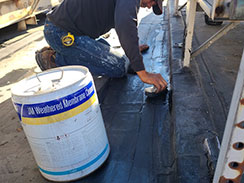
If you manage a commercial building in Huron, SD, a rubber roof leak should be diagnosed before anyone decides how to patch it. EPDM roofs can develop seam separation, punctures, flashing problems, membrane movement, and damage around penetrations, but those conditions do not all call for the same repair.
Hoppe Roofing has served commercial roofing customers since 1977 and provides rubber roofing and commercial roof repair services across South Dakota and the surrounding region. Call (855) 472-4932 to arrange an on-site estimate for a roof problem in Huron.
A Roof Inspection Should Map the Actual Defect

A ceiling stain or visible membrane problem helps direct the inspection, but it does not prove where water entered or how far the condition extends. The roof-level investigation should connect the visible symptom with the actual defect before the repair scope is approved.
- Seams and laps: Check whether a separation is isolated, whether nearby seams show similar deterioration, and whether the surrounding membrane remains serviceable.
- Punctures and tears: Confirm the size and location of the damage and whether the affected area extends beyond the visible opening.
- Perimeter movement: Look for membrane movement or pull-back at edges, walls, curbs, and other transition points.
- Penetrations and flashing: Inspect drains, vents, curbs, pitch pans, and other details where the membrane is cut, terminated, or sealed.
- Suspected moisture: If a soft or blistered area raises a moisture concern, determine whether further investigation is needed before covering the area with a repair.
Hoppe Roofing’s rubber roofing service describes inspection and repair support for commercial single-ply roofs. The useful question on this Huron page is whether the observed defect is contained enough for repair or points to a broader roof condition.
Use Repair Materials Compatible With the Existing EPDM
Once the defect is defined, the repair materials and preparation should match the existing membrane and the specific repair detail. A generic roofing patch should not be assumed compatible simply because it adheres to another roof surface.
For seam separation, a repair may require cleaning and preparing the existing membrane before approved seam materials are installed. A puncture may require an EPDM-compatible patch sized for the damaged area. Problems at edges or penetrations may require re-securing, re-flashing, or rebuilding the affected detail rather than placing sealant over the visible opening.
Hoppe Roofing also provides commercial flat roof repair. The written repair scope should identify the defect, preparation, repair method, materials, exclusions, and any condition that would require the work to expand.
When Is a Localized Repair Enough?
A localized repair may be appropriate when one seam, puncture, flashing detail, or penetration is clearly responsible for the problem and the nearby membrane and supporting materials remain serviceable. It becomes harder to justify another isolated patch when leaks recur in unrelated areas, multiple seams are failing, moisture extent is uncertain, or previous repairs repeatedly fail.
That does not mean every aging EPDM roof needs replacement. It means the contractor should explain the evidence supporting repair and identify what findings would trigger a broader assessment.
Verification Before the Repair Is Closed Out
A rubber roof repair should not be considered complete simply because a patch has been installed. The closeout process should confirm that the work matches the diagnosed defect and the approved repair scope.
Ask what completion check will be used, what repaired areas will be documented, and what follow-up is recommended if the original leak symptoms continue. Photos or written repair notes can help the owner maintain a useful roof history without turning one repair visit into a promise about the condition of the entire roof.
Plan Safe Access and Business Coordination
Building staff can provide interior leak locations, operating schedules, security requirements, and information about rooftop equipment. The roofing contractor should determine the safe roof-access route, staging, fall protection, and work-area controls. Owners and employees should not climb onto the roof to diagnose a suspected EPDM problem themselves.
Maintenance After a Rubber Roof Repair
A successful localized repair does not remove the need to keep watching the rest of the roof. Seams, penetrations, flashings, drains, repaired areas, and traffic paths should remain part of future condition checks. Hoppe Roofing’s commercial roof maintenance service provides additional context for ongoing roof inspections and upkeep.
Maintenance timing should reflect the roof’s age, condition, repair history, exposure, and any written system or warranty requirements rather than one fixed interval for every building.
Rubber Roof Repair in Huron, SD
855-472-4932
If your commercial rubber roof in Huron is leaking or showing visible damage, start by defining the defect and the limits of the affected area. Hoppe Roofing can inspect the roof and discuss whether the evidence supports a localized repair or a broader assessment. Call (855) 472-4932 to arrange an on-site estimate.
Frequently Asked Questions
How do I know whether an EPDM roof needs repair or a broader assessment?
A localized repair may fit when the defect and affected materials are clearly contained. Repeated failures, uncertain moisture extent, or problems across several roof areas support a broader assessment before more patching is approved.
Can any roofing patch be used on an EPDM membrane?
No. Repair materials should be compatible with the existing EPDM membrane and the specific repair detail, with preparation completed according to the applicable product requirements.
What should be documented after a rubber roof repair?
Useful closeout records identify the defect that was found, the area repaired, the repair method, and any follow-up recommendation for the owner.
Should building staff climb onto the roof to inspect a leak?
No. Staff can document interior symptoms and access information, while roof-level diagnosis and repair should follow the roofing contractor’s safety and access plan.