When a commercial flat roof in Fort Dodge reaches the end of its service life, the replacement decision involves more than scheduling a crew. Building owners also need to choose the right system for their specific building, budget, and long-term plans. The options differ meaningfully in terms of performance, cost, and installation requirements. A well-matched flat roof replacement in Fort Dodge, IA sets the building up for decades of reliable performance.
Call Hoppe Roofing at (855) 472-4932 for expert Fort Dodge, IA flat roof replacement services.
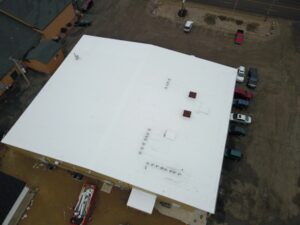
TPO vs. EPDM: The Two Most Common Flat Roof Replacement Systems
TPO (thermoplastic polyolefin) and EPDM (ethylene propylene diene monomer, a synthetic rubber) are the two systems installed most frequently on commercial flat roofs in north-central Iowa. TPO is a white thermoplastic membrane installed in large sheets with heat-welded seams. The welded seams create bonds stronger than the membrane itself, which eliminates seam separation as a long-term concern. The white surface also reflects solar heat, reducing summer cooling loads on Fort Dodge commercial buildings.
EPDM is a black or white synthetic rubber sheet typically adhered in place or held down with ballast, with seams bonded using adhesive or tape. It has a long track record in cold climates and performs well through Iowa’s freeze-thaw cycles due to its inherent flexibility. EPDM is often the lower-cost option at installation, though its dark surface absorbs more solar heat than a reflective TPO system.
Spray Foam as a Flat Roof Replacement Alternative
Spray polyurethane foam (SPF) is a third option that works differently from either membrane system. Applied as a liquid that expands into solid foam, SPF creates a seamless, self-flashing surface that conforms to the existing deck and flows around penetrations without separate flashing components. The foam itself provides insulation value, and a silicone or acrylic topcoat provides UV and weather protection. SPF is particularly well suited to buildings with complex rooftop geometry or numerous penetrations.

Choosing the Right System for Your Fort Dodge Building
The best replacement system for a given building depends on several factors. Buildings with flat, uncluttered roof decks and straightforward drainage benefit from either TPO or EPDM, with TPO offering the energy efficiency advantage and EPDM offering lower installation cost. Buildings with many penetrations, rooftop units, or unusual geometry often benefit from spray foam’s self-flashing properties. Deck condition also matters: a replacement project is the right time to assess whether the existing insulation and deck need work before the new membrane goes down.
Expert Fort Dodge Flat Roof Replacement
Hoppe Roofing has installed and maintained commercial flat roofing systems across north-central Iowa since 1977. As a veteran-owned business with more than 45 years of experience, the team has worked with every major replacement system and can assess which option fits a given building’s needs, condition, and budget.
For expert flat roof replacement in Fort Dodge, IA, contact Hoppe Roofing at (855) 472-4932 today.
FAQ
Is TPO or EPDM the better choice for a Fort Dodge commercial building?
Both perform well in Iowa’s climate. TPO offers stronger seam durability through heat welding and better energy efficiency from its reflective surface. EPDM typically costs less to install and has a long track record in cold climates. The right choice depends on the building’s drainage, rooftop equipment layout, and energy goals. A contractor assessment will weigh those factors for the specific building.
Can spray foam be installed over an existing flat roof rather than doing a full tear-off?
In many cases, yes. Spray foam can be applied directly over a clean, dry existing membrane, which eliminates tear-off cost and keeps the old material out of the waste stream. The existing surface must be in suitable condition and properly prepared before the foam is applied. Your contractor will assess whether the deck and existing membrane are appropriate candidates for an overlay installation.
What happens to the existing insulation during a flat roof replacement?
The condition of the existing insulation is assessed during the project. Dry insulation in good condition is typically left in place to reduce waste and cost. Insulation that has absorbed moisture must be removed and replaced, since wet insulation loses its thermal value and adds weight to the deck. A thermal scan or core sample during the initial inspection identifies which areas require replacement.