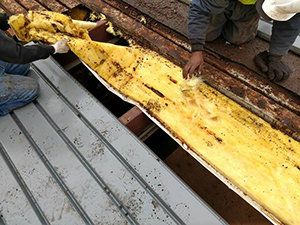
Flat and low-slope roofs are common on commercial and industrial buildings, and water, wind and temperature swings can expose weaknesses in their seams, flashing and drainage. These conditions affect roof materials in different ways, and knowing which one you are dealing with helps you decide whether you have a localized problem that a repair can fix or damage that calls for a broader assessment.
Hoppe Roofing serves commercial property owners across its South Dakota, Iowa and Minnesota service areas. For flat roof repair, call 855-472-4932 to discuss an inspection and repair assessment.
Flat Roof Repair Causes
Water
Water ponding is one of the biggest weather-related concerns for flat roofs. Water that stays on the roof can lead to leaks and membrane wear, and the added weight can stress the structure. Drainage is the first thing to evaluate: whether drains and scuppers are clear, whether the roof slopes toward them, and whether low spots hold water after rain. A roofer can recommend corrections, such as drain work or tapered insulation, based on what the roof actually needs.
Wind

High winds can push debris onto a roof, where it can clog drains, and they can lift or loosen the membrane, especially at edges and corners. Securely attached membranes, sound edge metal, and sealed penetrations such as vents and skylights reduce the risk. After a major wind event, have the roof looked at by a qualified crew, since loosened edges and flashings are easy to miss from the ground.
Extreme Temperatures
South Dakota, Iowa, and Minnesota roofs go through hot summers and hard winters. Heat and sunlight can dry out and crack some membranes, cold can make them brittle, and ultraviolet exposure can cause fading and surface wear. Repeated expansion and contraction also works on seams and flashings. A roof system and any coating should suit the climate and the roof it goes on. An aging roof that is still sound may be a candidate for flat roof coatings, depending on what an inspection finds.
Repairable Defect or Broader Problem?
A leak does not always require a large repair, and a small stain does not prove the damage is small. The table below shows how common symptoms relate to what an inspection should confirm.
| What you notice | What an inspection should confirm | What it usually points to |
|---|---|---|
| Open or separated seams | Length and condition of the seam, and whether nearby membrane is sound | A localized seam repair is often possible if the surrounding roof is in good condition |
| Leak near a vent, curb, or rooftop unit | Condition of the seal or boot at the penetration, and whether water has moved beyond it | A detail repair at that penetration |
| Water at walls or roof edges | Flashing attachment, cracking, and edge metal | Flashing repair or replacement along the affected run |
| Ceiling stain or soft area | Whether concealed moisture has spread through insulation or reached the deck | Further assessment before setting the repair area because a stain alone does not show the extent |
| Standing water after rain | Slope, drain condition, and debris | Drainage corrections plus repair of any membrane wear beneath the pond |
| Repeated leaks in different spots | Overall membrane age and condition | A broader assessment of repair versus replacement |
Limits of a Localized Repair
A targeted repair makes sense when the defect is isolated, the surrounding membrane has useful life left, and insulation under the repair area is dry. It is less effective when moisture has spread through the insulation, when the membrane is worn across large areas, or when leaks keep appearing in new places. In those cases, patching the visible spot can leave the underlying problem in place. Avoid diagnosing hidden damage from a stain alone, and leave roof access to qualified crews.
What a Repair Quote Should Include
A good quote identifies the repair area and how it was determined, what happens if wet insulation or deck damage is found, how flashings and penetrations are handled, and what is excluded. It should also cover access planning, such as where equipment will be staged and how building occupants stay clear of the work area. If findings point to a bigger project, ask for the comparison to commercial roof replacement in writing.
Preventive Maintenance
Regular inspections and maintenance help identify problems before they grow. Clearing debris from drains, checking seams and flashings, and addressing items found during the inspection are routine parts of a roof maintenance program. A roof inspection can evaluate the roofing materials, drainage equipment, flashings, and signs of movement, so you have a clear record to plan from.
Discuss Your Flat Roof Repair
855-472-4932
Weather affects every flat roof differently, and the right fix depends on what the roof shows. Call Hoppe Roofing at 855-472-4932 to schedule an inspection and get a clear plan for your building.
Frequently Asked Questions
What causes most flat roof leaks?
Ponding water, loose or damaged seams and flashings, wind damage, and membrane wear from sun and temperature swings are common causes. An inspection identifies which applies to your roof.
Can a stain on the ceiling tell me how bad the roof damage is?
No. Water can travel before it shows up inside, so a stain does not show where the water entered or how far moisture has spread.
When is a localized repair enough?
When the defect is isolated, the surrounding membrane is in good condition, and the insulation beneath is dry. Otherwise a broader assessment is usually needed.
How often should a flat roof be inspected?
Many owners schedule inspections in spring and fall, plus after severe weather such as hail or high winds.